The Campaign against Criminal Poisoning of European Wildlife (CPEW)
The Issue
Dear Ladies and Gentlemen,
Dear Members of the European Parliament,
With this letter we ask the European Union to take action to counteract illegal poisoning of our wildlife in Europe.
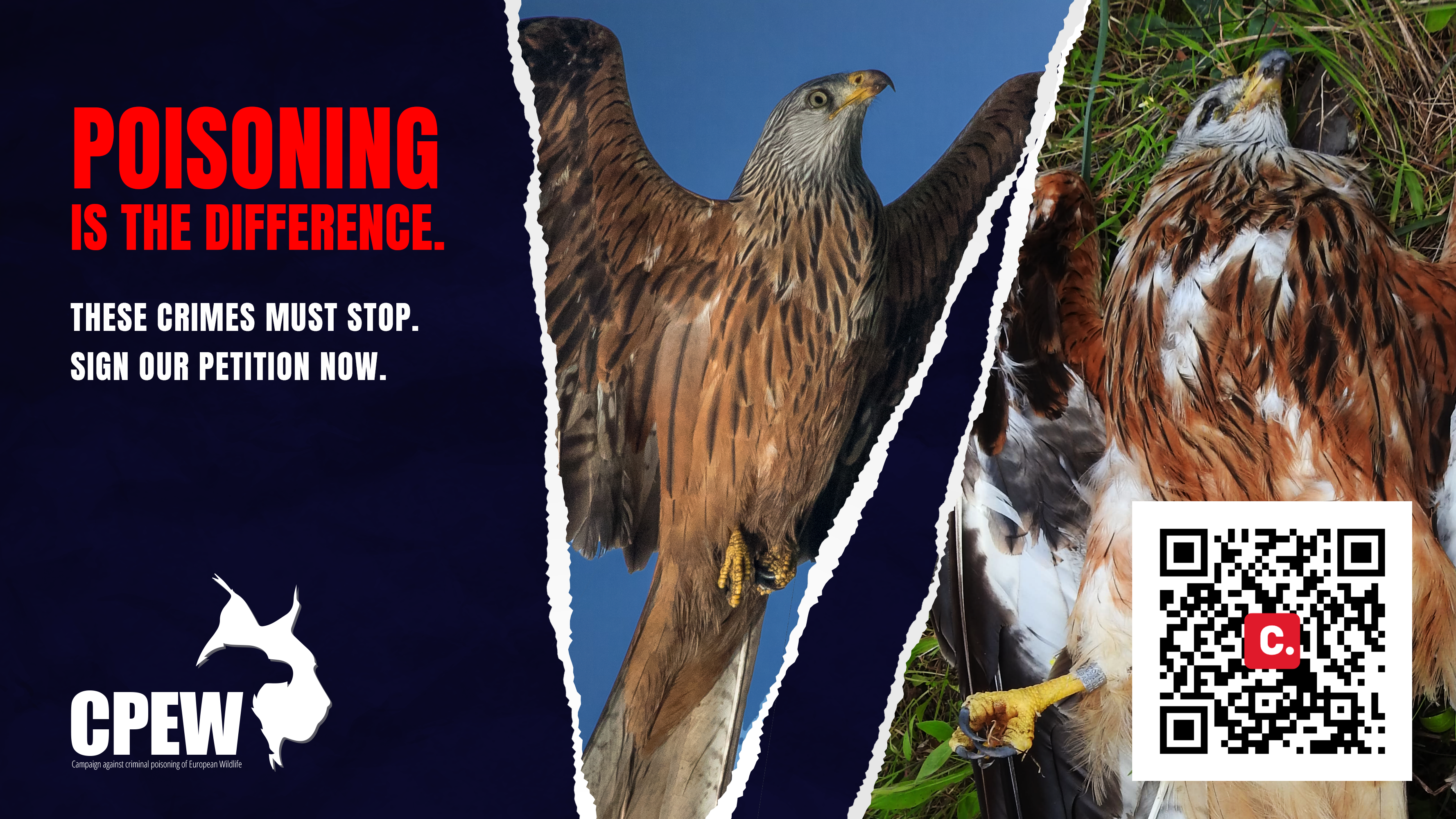
In the course of the LIFE EUROKITE project (LIFE18 NAT/AT/000048) “cross-border protection of the red kite in Europe by reducing human-caused mortality”, together with various supporters e. g. other LIFE projects and different organisations, we aim to get to the root of the anthropogenic mortality reasons. Illegal poisoning is threatening many rare and protected species of birds and mammals and endangering the public and their pets. The first data of the LIFE EUROKITE project indicates that poisoning is by far the main human-caused mortality reason for red kites.
Many of the Species Action Plans (around 50 bird species), developed by BirdLife International and funded by the EU, recognise poisoning as a threat and recommend anti-poisoning actions in most of the plans for raptors (e. g. both imperial eagles, all vultures and red kites).
Very large numbers of animals are killed every year as a result of deliberate misuse or otherwise illegal use of poisons. This unnecessary mortality can severely affect the conservation status of vulnerable species, including species protected under national, EU and wider international law. A transboundary approach at EU level is needed to address this problem in the case of migratory species.
It is time now that the European Union takes action to counteract illegal poisoning of our wildlife in Europe.
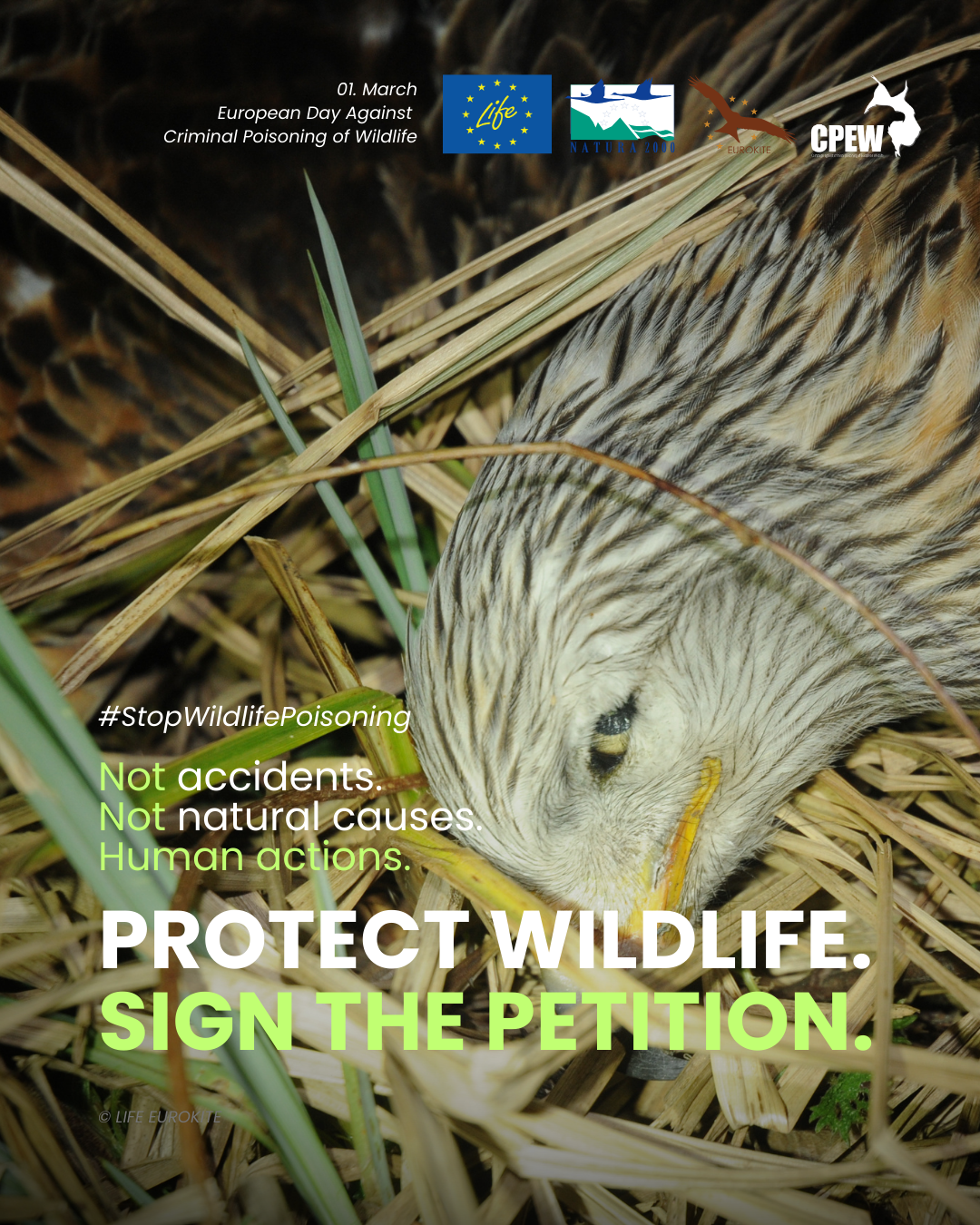
➔ Supporting the “European day against criminal poisoning of wildlife” on 1st March to raise awareness of the general public and the political decision makers, as the topic is widely underestimated and unknown.
➔Systematic data collection for whole Europe to create a poisoning data base and to identify hot spots. Ideally, this data base should be managed by the European Union or one of its organisations.
➔Need to pursue the Rome Strategic Plan 2020-2030 further and more vigorously.
Help us and sign this petition!
The Campaign against Criminal Poisoning of European Wildlife (CPEW)
https://stopwildlifepoisoning.eu/
LIFE EUROKITE Crime Report
The LIFE EUROKITE project (LIFE18 NAT/AT/000048) is a cross-border protection project for the red kite and other raptor species in Europe. Within the LIFE EUROKITE project the core idea is to use telemetry technology to identify the spatial habitat use of the target raptor species, quantify the key reasons of mortality of bird of prey species in the EU and reduce human-caused mortality, particularly illegal activities such as poisoning.
Between 2013 and 2024, 3,554 individuals of 7 raptor species (3,161 red kites, 97 black kites, 43 booted eagles, 52 honey buzzards, 79 imperial eagles, 22 ospreys and 100 white-tailed eagles) were tagged with solar-powered GPS satellite tags in 19 countries across Europe with the help of many project partners and cooperation partners. From this a total of 1,795 individuals (1,680 red kites, 37 black kites, 18 honey buzzards, 29 imperial eagles and 31 white-tailed eagles) were tagged within the LIFE EUROKITE project.
From the 3,554 tagged birds a total of 1,623 died so far. Of these, a total of 1,594 individuals (1,480 red kites, 13 black kites, 14 booted eagles, 17 honey buzzards, 32 imperial eagles, 8 ospreys, 30 white-tailed eagles) died in the respective country where we also detected bird persecution within our sample. The first results of the LIFE EUROKITE project show, that 320 (20.08 %) of the tagged birds (293; 19.80 % red kites, 3; 23.08 % black kites, 1; 7.14 % booted eagles, 2; 11.76 % honey buzzards, 12; 37.50 % imperial eagles, 1; 12.50 % ospreys, 8; 26.67 % white-tailed eagles) were victims of illegal activities in 24 countries (10/01/2025). Poisoning (n= 238; 74.38 % of illegal activities) was by far the most common illegal act that caused the death of these tagged birds. The most used poison was Carbofuran which is banned in the EU since 2008. The second most common illegal act that caused the death of these tagged birds was shooting (66 individuals; 20.63 % of illegal activities). Of the 320 birds that were tagged and illegally killed, only 8 cases resulted in a conviction for bird persecution.
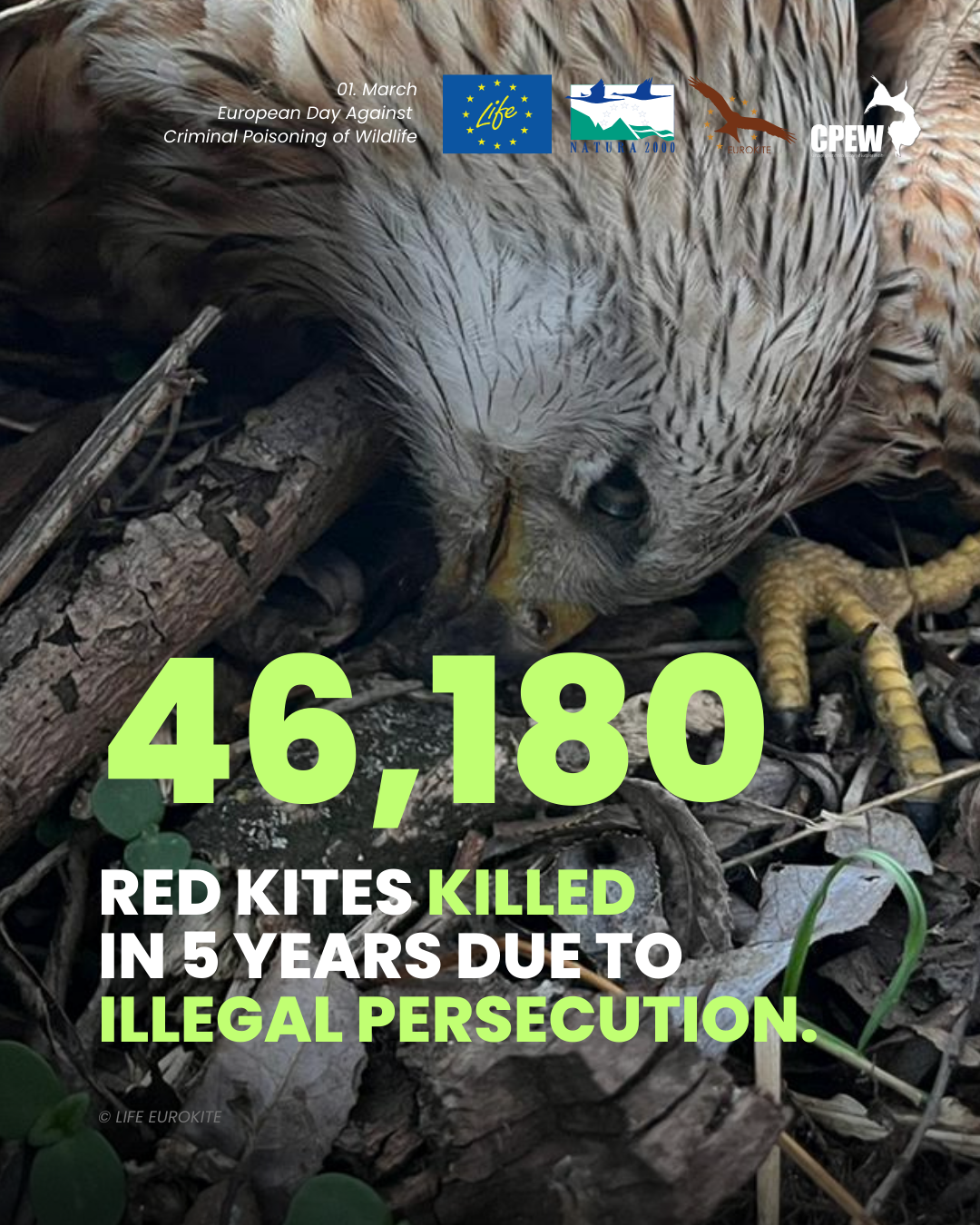
When extrapolating the data on illegal bird persecution over the past five years (2020–2024), it is estimated that approximately 46,180 red kites have died as a result of persecution. This estimate is derived by scaling up known persecution rates of tagged birds to the entire European red kite population, based on published population size estimates, average annual mortality rates, and the proportion of mortality attributed to illegal killing. It therefore reflects a population-level extrapolation, not a direct count of detected cases.
Due to varying numbers of tagged individuals and differing red kite population densities across countries, the results may vary considerably. Consequently, these findings do not allow for conclusions regarding the statistical frequency of illegal activities relative to red kite density in any given country.
Bird persecution in Europe persists all over Europe. Effective conservation requires stronger law enforcement, public education, international cooperation, and better tools like GPS tracking to detect and prosecute offenders. Political commitment across countries is crucial, along with harmonized laws, stricter penalties, and national action plans with clear goals. Raising awareness through initiatives like the “European Day Against Criminal Poisoning of Wildlife” and systematic data collection can help inform both the public and policymakers. Finally, stronger cross-border collaboration and support for monitoring and reporting systems are essential to address bird persecution at a European level.