
On Albania’s southwestern coast, where the Vjosa – one of Europe’s last great wild rivers – arrives at the Adriatic, the river spreads into a vast mosaic of lagoons, salt marshes, and coastal forest. This is a landscape without hard edges. Where river becomes lagoon, lagoon becomes marsh, and the line between water and land is never quite where you expect it.
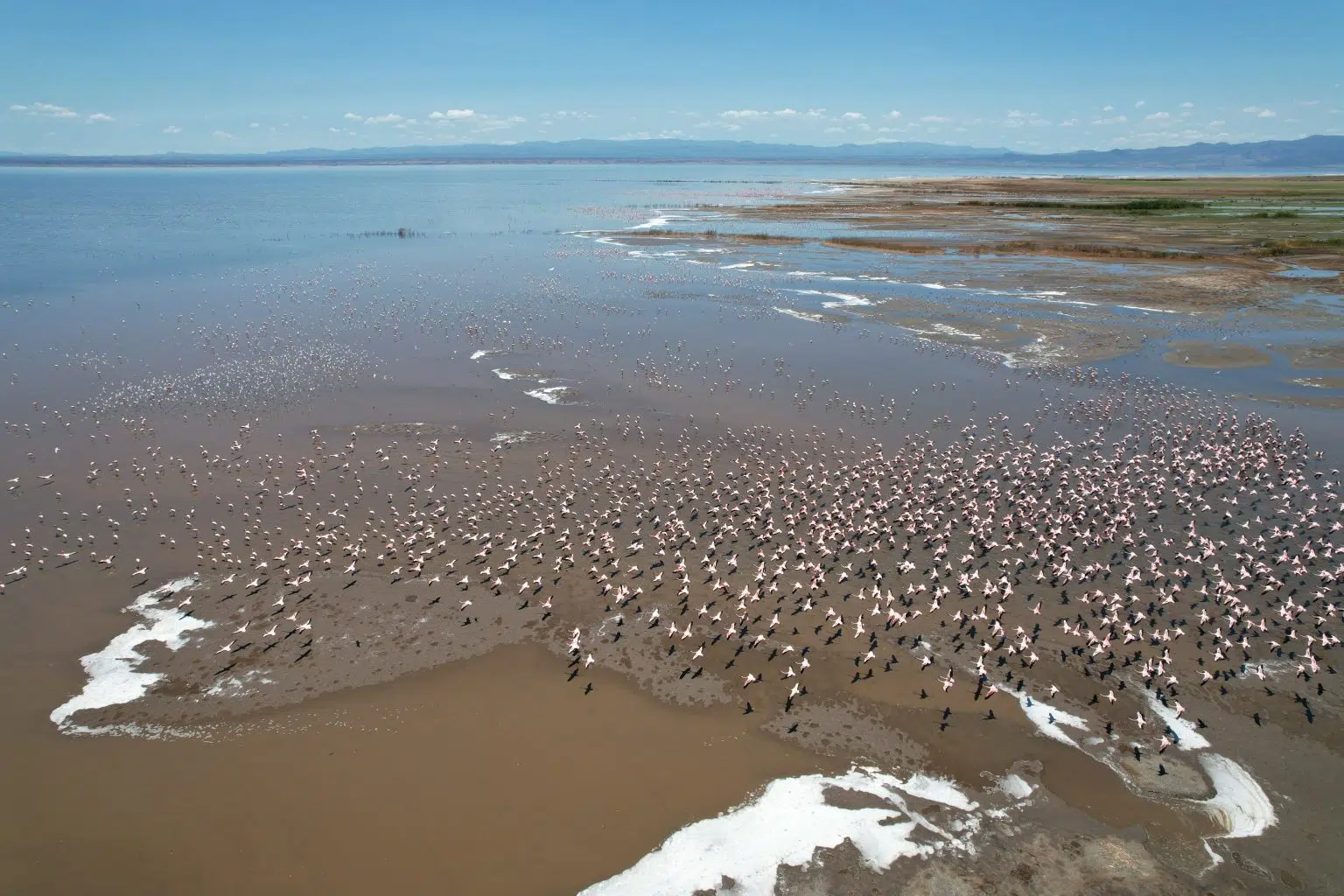
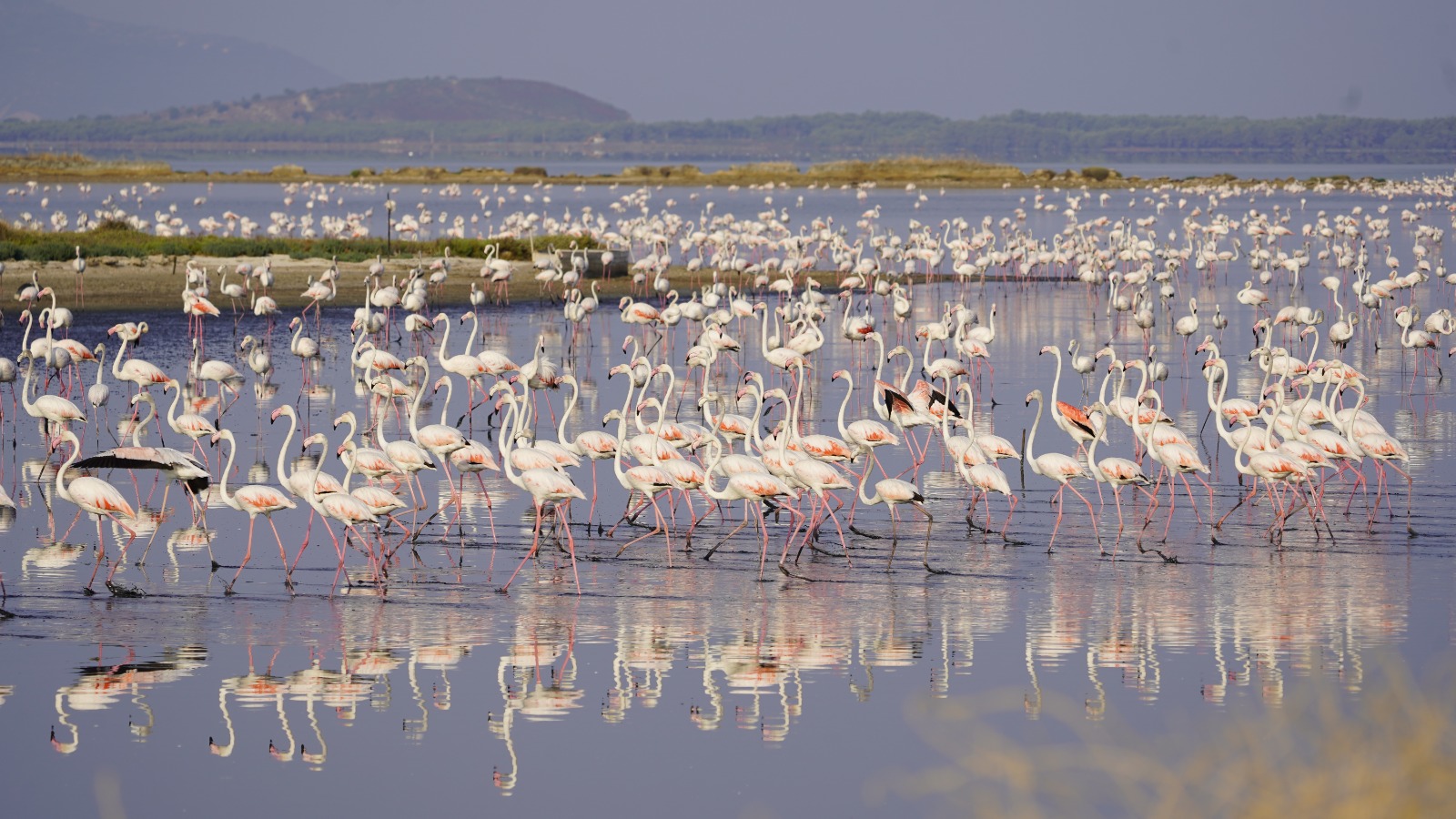
At dawn, the light comes in layers. Mist sits above still water. The first sun catches the reeds. And then, the flamingos; pale pink, motionless, their reflections perfect in the glass-flat lagoon. Dalmatian pelicans pass overhead with the unhurried ease of creatures that have never needed to rush. Egrets work the shallows. Herons stand sentinel at the water’s edge. The whole scene has the quality of something you might not quite believe you are seeing.
Behind the lagoon, the ancient pine forest begins. These trees have stood long enough to have grown into something architectural. Their roots anchored deep in sandy soil shaped by centuries of salt wind, their canopies filtering the light into shifting patterns on the forest floor, the scent of pine and sea arriving together. They are, in the truest sense, irreplaceable. For millions of migratory birds travelling the Adriatic Flyway, one of Europe’s most critical corridors between breeding grounds in the north and wintering grounds in Africa, this forest is the last shelter before open water, or the first solid ground after the crossing. A Wood Warbler, a Wryneck, a Collared Flycatcher; each one pauses here, in these particular trees, before continuing a journey that spans continents. There is no substitute for a forest of this age on a flyway of this importance.
Beyond the trees, the dunes roll toward the sea in soft, unhurried waves of gold. Sculpted by wind and tide over centuries, they are both beautiful and structural. The dune belt is the physical boundary between the saline lagoon system and the open Adriatic, the barrier that absorbs storm surges, prevents saltwater intrusion, and makes the wetland behind it habitable. Wildflowers find footing in what looks like impossible terrain. Loggerhead sea turtles, ancient navigators, returning always to the beach where they were born, come ashore here to nest, as they have done since long before this coastline had a name.
This is Pishë Poro–Nartë, the core of the Vjosa–Narta Protected Landscape. The wider delta spans more than 250 square kilometres and holds 18 habitat types listed under the EU’s Natura 2000 framework, six of them EU priority habitats – the classification reserved for ecosystems of the highest ecological significance. More than 2,300 species depend on it. Among them, the Mediterranean monk seal, one of the world’s most endangered marine mammals, with only a few hundred individuals remaining. The Dalmatian pelican, which came back from the edge of local extinction in Europe partly because places like this still existed. Over 70 species classified as endangered. The Narta lagoon meets the criteria of the Ramsar Convention on Wetlands, an international threshold for ecological significance that this landscape clears with ease. It is one of the finest remaining wild coastlines in the Mediterranean. At dusk, as the flamingos gather on the lagoon and the old pines cast long shadows across the dunes, that feels like an understatement.
Since late April 2026, bulldozers have been moving through it.
Heavy machinery arrived at Pishë Poro–Nartë without a published project, without an environmental impact assessment, without public consultation. Roads have been cut through ancient pine forest. Sand dunes designated as Natural Monuments under Albanian law have had gravel dumped onto them. New roads have been cut through previously untouched habitat, causing disruption to the breeding and migration cycles the whole ecosystem depends on. Scientists say that without active restoration efforts, the damage to the dune system alone will take centuries to repair. And the losses are not separate: the lagoon is hydrologically coupled to the forest and dunes around it. Destroy one, and you degrade the salinity, the water quality, the breeding margins that make the whole system function. Trucks and bulldozers are dismantling an interconnected living system, piece by irreplaceable piece.
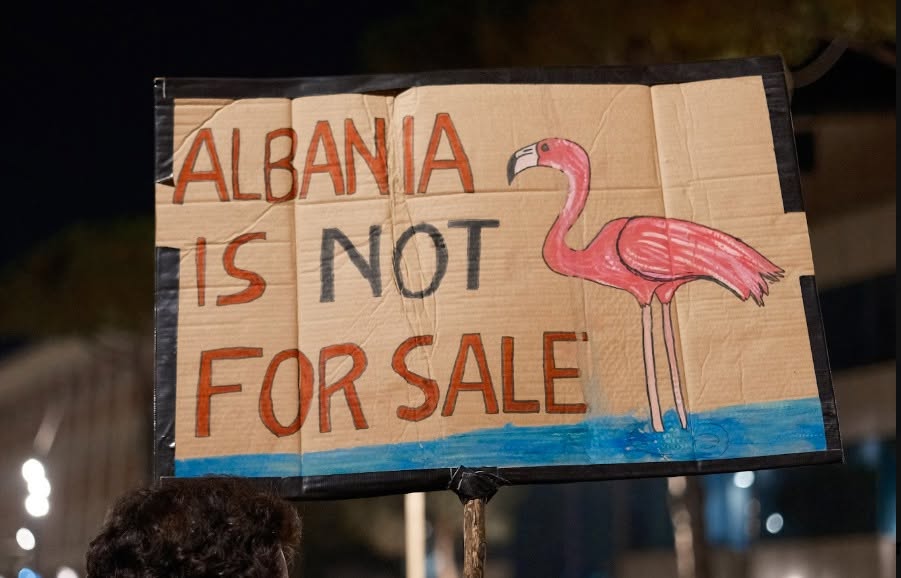
The destruction is linked to a luxury resort development backed by Jared Kushner and Ivanka Trump, who said in May she was “just captivated” after swimming to a nearby island and described the project as “the culmination of all of my experience in real estate.” Prime Minister Edi Rama has confirmed the connection and defended the development; his office says projects should not be condemned before they exist. The Albanian government claims the works are for technical surveys and environmental measurements rather than construction. Since the plans have been revealed, hundreds of thousands of Albanians have taken to the streets of Tirana every day, armed with pink flamingos and devotion to this wildlife sanctuary.
Works have halted, for now. The government says the project continues. It must not. The only acceptable outcome is the complete abandonment of the development, active restoration of what can still be brought back, and genuine legal protection that cannot be amended away by the next government that finds a willing investor.
This is not an argument against tourism. But there is a difference between tourism that works with a place and tourism that consumes it. The ancient pines, the dunes, the glass-flat lagoon at dawn – these are exactly the kind of landscapes that draw travellers who want something real. That kind of tourism is possible here, and infrastructure can be developed in the already-degraded and urbanised areas at the margins of the delta. What cannot be managed is the loss of the habitat itself. The dunes will not recover if machinery returns next season. The forest cannot grow back on a developer’s timeline. The monk seal, the pelican, the turtle – they do not have a contingency plan.
What is being asked is not complicated. Stop. Reverse. Protect. Give this landscape, which has sheltered life through centuries of storm and migration and change, which remains one of the last places in the Mediterranean where nature still moves according to its own logic, the chance to continue doing what it has always done.
The flamingos have not left yet. Whether they stay depends entirely on what happens next.
Written by Honey Kohan, Head of Communications, BirdLife Europe and Central Asia.
Source: Vjosa-Narta: Europe’s last wild coast – BirdLife International