
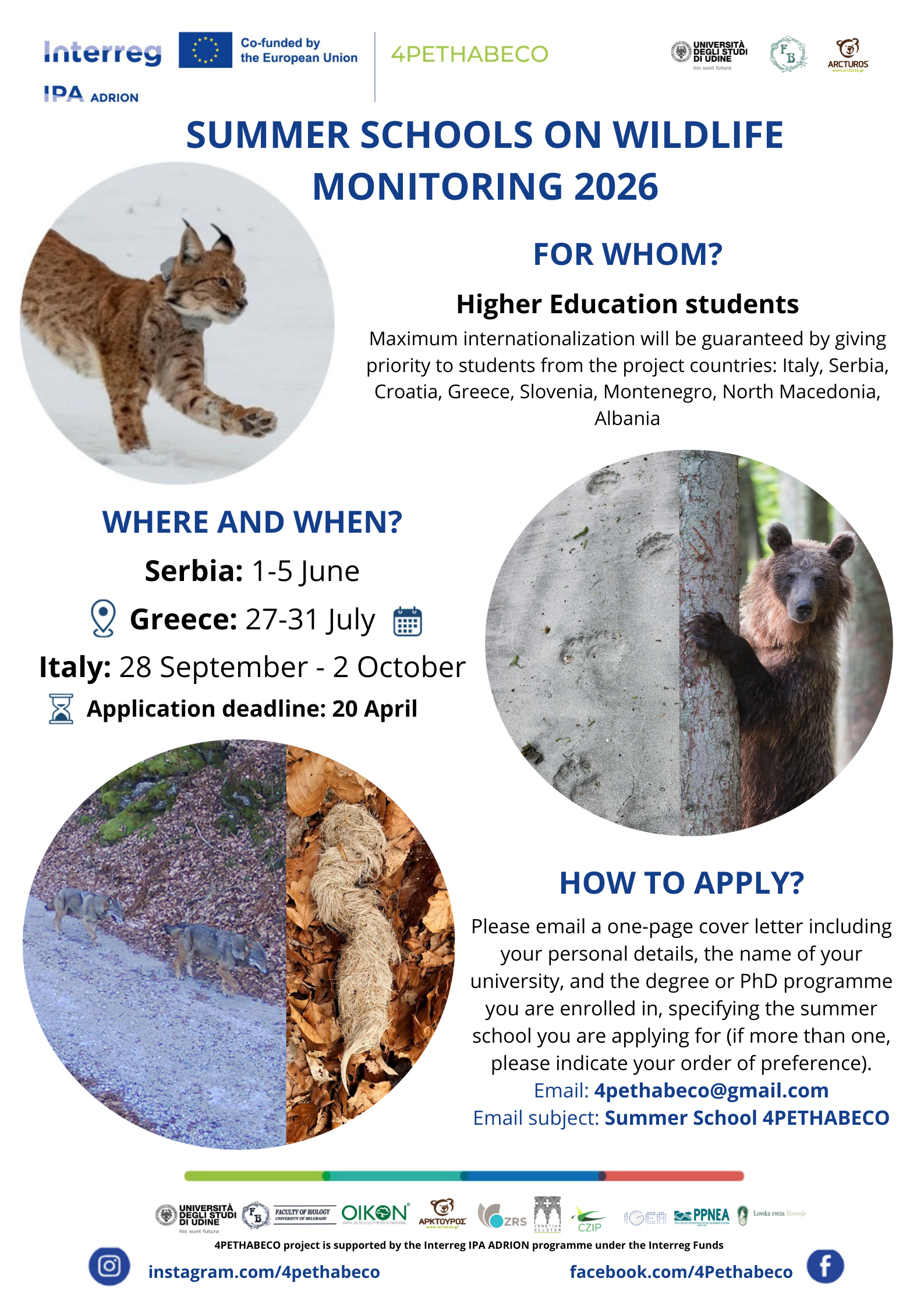
Summer school on wildlife monitoring at Tara Mountain, National Park – Serbia
Organiser: University of Belgrade – Faculty of Biology
Dates: 1 June, 2.00 pm – 5 June, 1.00 pm
Location: Tara National Park, Mitrovac. Details on the meeting point will follow.
Maximum number of participants: 10 HEI students
Overview
This summer school focuses on monitoring large carnivores (LCs), particularly brown bears, in Tara National Park, one of the most important bear habitats in Serbia. The programme combines theoretical lectures, fieldwork, data collection and introductory analytical methods.
Main activities
- Theoretical introduction to the LCs inhabiting the study area, as well as to the key conservation activities currently being implemented at improving habitat quality, enhancing ecological connectivity, and fostering coexistence between humans and wildlife. As Tara National Park hosts the largest bear population in Serbia, the primary focus of this summer school will be on this species.
- Bear trapping (followed by GPS collaring in the event of successful capture).
- Training on innovative monitoring techniques, including telemetry, camera trapping, non-invasive sampling methods, and field-based identification of carnivore presence through track and sign surveys.
- Lectures on the role of feeding sites as an important wildlife management tool.
- Workshops on human-wildlife coexistence and conflict mitigation.
- Training on the analytical dimension of LC research. introduction to GIS and R for ecological data analysis.
Accommodation
Participants will stay at the Educational Center Mitrovac, offering 8 double and 1 triple fully equipped rooms with private bathrooms. The center also includes an on-site restaurant and conference facilities where lectures and indoor sessions will be held.
Costs covered
- Accommodation
- Meals
- Local transport during course activities
Coverage period: from lunch on 1 June to breakfast on 5 June.
Logistics
Participants should bring suitable mountain clothing (layering is recommended), hiking boots, flashlight, reusable water bottle, power banks and laptop for data analysis sessions. Binoculars, measuring tape and GPS devices are recommended if available.
It is possible to help organize the accommodation for the nights before and after the summer school, but this cost is not covered by the organization.
Teaching staff
The course will be led by researchers and wildlife biologists from the University of Belgrade – Faculty of Biology, with expertise in the monitoring of large and mesocarnivores, as well as technical staff from the Tara National Park:
- Dr. Duško Ćirović, Dr. Aleksandra Penezić, Dr. Neda Bogdanović, and MSc Ilija Pantelić will be the wildlife experts leading the summer school
- Professional staff from Tara National Park will be present throughout the program to support and guide all field-based activities.


Summer school on wildlife monitoring in Nymfaio – Greece
Organiser: ARCTUROS
Dates: 27 July, 2.00pm – 31 July, 1.00pm
Location: Nymfaio village, Vitsi mountain range, Northern Greece. Details on the meeting point will follow.
Maximum number of participants: 10 HEI students
Overview
This summer school combines theoretical training, field activities and visits to ARCTUROS wildlife facilities, focusing on large carnivore (LC) monitoring and strategies to improve human–wildlife coexistence. The course will take place within the Vitsi mountains, in the field (mountains and lakes), and at the headquarters and wildlife sanctuaries of ARCTUROS.
Main activities
- Specialist lectures on LC monitoring and conservation, habitat protection and eco-connectivity
- Training on in situ wildlife monitoring techniques including camera trapping, genetic sampling and biosignature tracking
- Training on ex situ conservation practices in ARCTUROS’ wildlife sanctuaries, including ethology and rehabilitation
- Training on data collection, management, and display
- Workshops on human-wildlife coexistence and conflict mitigation
Target species include bear, wolf, jackal and deer, as well as other mammals and birds of prey.
Accommodation
Participants will stay at the Mountain Education Centre of Nymfaio,YMCA, a fully equipped facility located in a natural mountain environment with shared rooms, bathrooms, food services and common indoor and outdoor areas for educational activities.
Costs covered:
- Accomodation
- Meals
- Local transport during course activities
Coverage period: from dinner on 27 July to breakfast on 31 July.
Travel to and from Amyntaio meeting point is at the participants’ own expense.
Logistics
Participants should bring mountain-appropriate clothing, hiking boots, flashlight, reusable water bottle, hat and sunscreen, power bank, laptop or notebook and a sleeping bag (essential for the overnight stay in the mountain hut). Binoculars and GPS devices are recommended if available.
Please fly in to the international airport of Makedonia in Thessaloniki and catch the 11:30am (or earlier) Thessaloniki to Florina KTEL bus to Amyntaio for pick up. Please note it takes approximately 1 hour to get from the airport to the KTEL central bus station. ARCTUROS staff will help with the logisitics prior to arrival.
Teaching staff
The course will be led by researchers and wildlife biologists from ARCTUROS, experts in the monitoring of large and meso-carnivores, and technical staff from the Mountain Education Centre of Nymfaio. Dr. Zoe Skalkos, and Mr. Lampros Krampokoukis will be the wildlife experts leading the summer school.


Summer school on wildlife monitoring at Prealpi Giulie Natural Park – Italy
Organiser: University of Udine
Dates: 28 September, 1.00 pm – 2 October 2026, 3.00 pm
Location: Julian Prealps Natural Park (UNESCO MAB Julian Alps Biosphere Reserve). Details on the meeting point will follow.
Maximum number of participants: 16 HEI students
Overview
This summer school provides advanced training in large carnivore (LC) and mesocarnivore monitoring within the Julian Prealps Natural Park. The programme combines theoretical lectures (at La Casa Resiana, Stolvizza and the Park Headquarters in Prato di Resia) and field-based activities in the natural areas of the Park, introducing students to innovative monitoring methods and participatory approaches to human–wildlife coexistence.
Main activities
- Specialist lectures on LC and mesocarnivore conservation, habitat protection, and eco-connectivity
- Practical demonstrations of monitoring techniques for LCs and mesocarnivores (bear, wolf, jackal, otter): camera trapping, bioacoustic monitoring, hair traps and thermal imaging
- Workshops on human-LC conflict mitigation and the “Living Labs” participatory approach
- Training on digital tools and citizen science methodologies
Accommodation
Participants will stay at La Casa Resiana located in Val Resia (Hostjie, Stolvizza), within the Julian Prealps Natural Park. The facility offers shared rooms, two bathrooms (separate for males and females), common spaces and outdoor areas. Please note that La Casa Resiana is accessible only on foot, via a walk of approximately 15 minutes. One overnight stay will take place in a traditional mountain hut (casera) in a remote natural area.
Costs covered:
- Accommodation
- Meals
- Local transport during course activities, and from Udine to Resia and return
Coverage period: from lunch on 28 September to lunch on 2 October.
Logistics
Participants should bring suitable mountain clothing (layered clothing recommended), hiking boots and a sleeping bag for the overnight stay in the mountain hut. Binoculars, measuring tapes for footprint measurements, GPS devices or smartphone apps for geolocation are recommended if available.
It is possible to organize the accomodation for the previous night, but this cost is not covered by the organization.
Teaching staff
The course will be led by researchers from the University of Udine, experts in the monitoring of large and mesocarnivores, and technical staff from the Julian Prealps Nature Park:
- Stefano Filacorda, University of Udine
- Stefano Santi, Director of the Julian Prealps Nature Park
- Cristina Comuzzo, Technician at the Julian Prealps Nature Park
- Virginia Barca, Researcher at the University of Udine
- Marco Favalli, Freelance Professional and Wildlife Expert and other expert
- Researchers from Italy and different partners of 4PETHABECO project


How to apply
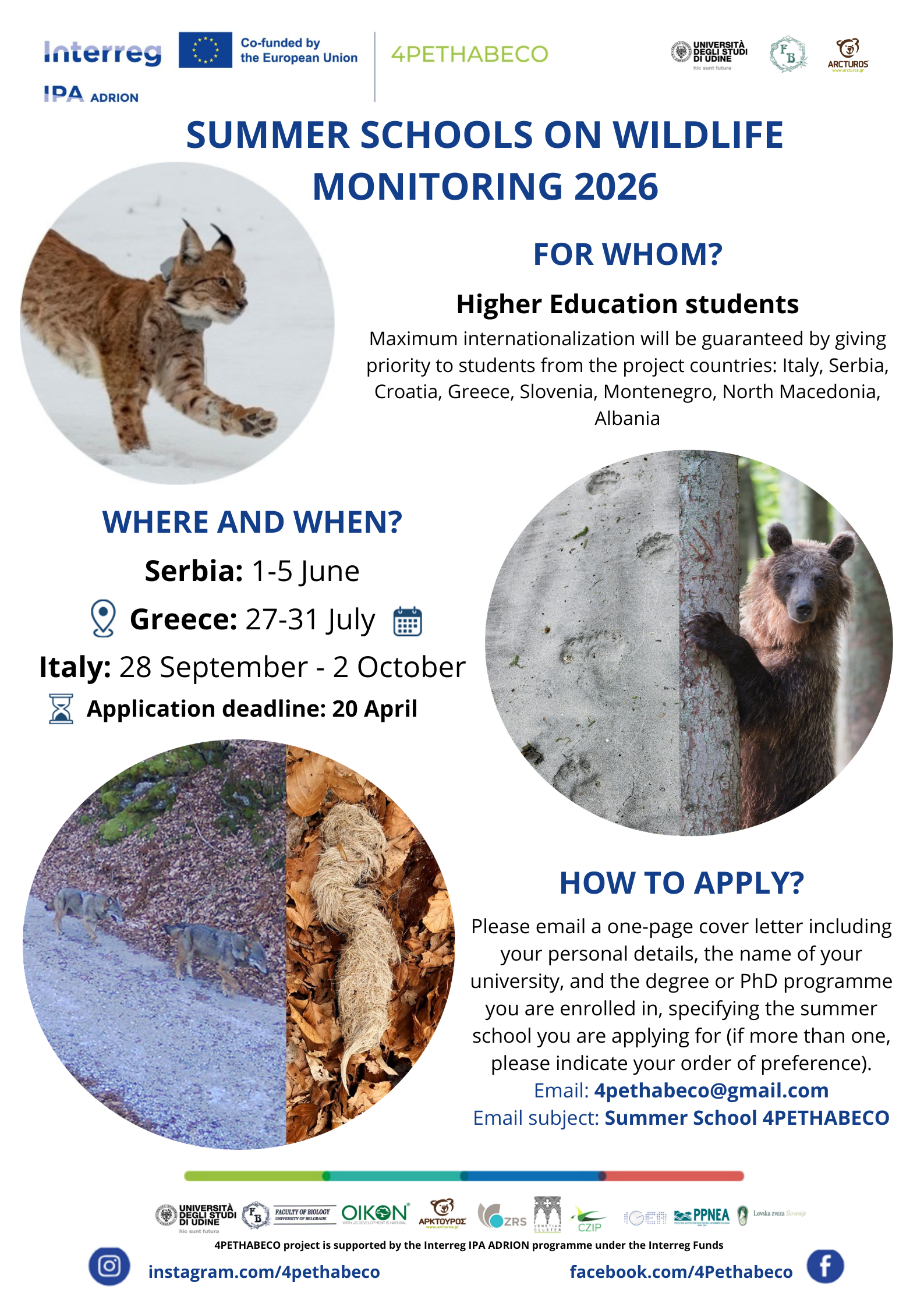
Interested Higher Education students should submit their applications by April 20th to the following email: [email protected]
Email subject: Summer School 4PETHABECO
Please attach a one-page cover letter to your email, stating your personal details (first name, surname, date of birth, address, nationality), your home university, the degree or PhD programme you are enrolled on, and the summer school you are applying for (if you have listed more than one, please specify your order of preference).
Each student may participate in only one summer school.
Maximum internationalization and gender equality will be guaranteed by giving priority to students from the project countries: Italy, Serbia, Croatia, Greece, Slovenia, Montenegro, North Macedonia, Albania.